
Measles on the Rise-Protect You and Your Family with Vaccination
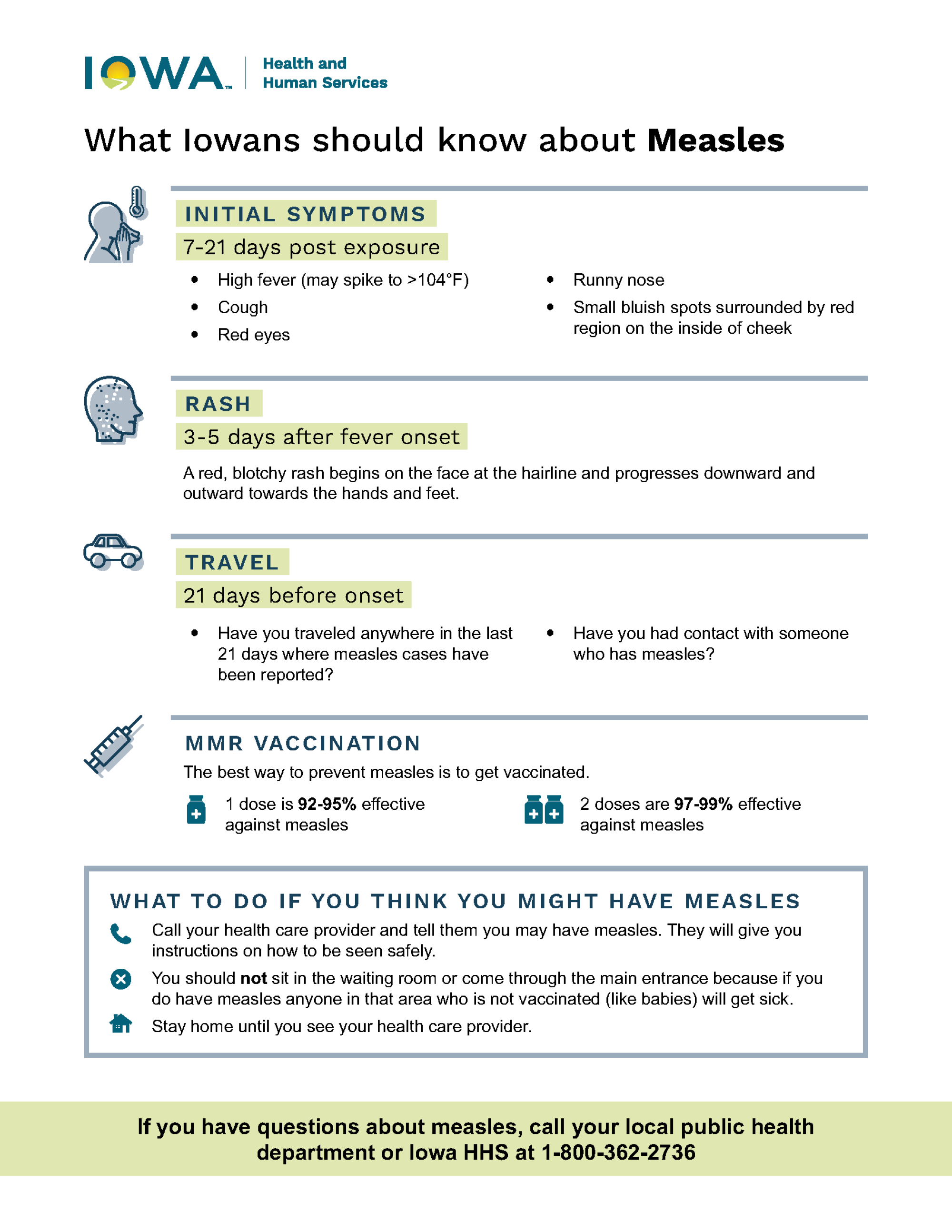
Measles cases are on the rise and are highly contagious. Measles spreads through the air when an infected person coughs or sneezes. The best way to prevent measles is to get the measles-mumps-rubella shot (called MMR). The MMR vaccine is very safe and effective. Two doses of MMR vaccine are about 97% effective at preventing measles; one dose is about 93% effective.
Two doses of MMR are required for elementary and secondary school entry in Iowa. The first dose should be given at 12 to 15 months of age and the second dose is usually administered as part of the kindergarten shots given between 4-6 years of age. Generally, persons who started elementary school in Iowa after 1991 and were up-to-date on all school entry vaccine requirements have received two doses of MMR vaccine.
Preventing the spread of measles is very important. According to Iowa Health and Human Services, among the unvaccinated people in the United States who get the measles, 1 in 5 are hospitalized; 1 in 20 children develop pneumonia; 1 in 1,000 children develop brain swelling and 1-3 in 1,000 children die from complications.
The MMR vaccine is safe and does not spread measles. A mild fever or rash can occur 7-12 days after vaccination; this usually does not mean the person is contagious.
There are several ways to know if you are protected from measles, including the following: 1) You have received the recommended number of MMR vaccines for your age and risk, 2) A lab test shows you had measles or a measles vaccine at some point in your life, and 3) You were born before 1957.
Giving vaccines to those who may have already had measles or may have already received the recommended vaccination is not harmful; it only boosts immunity. Therefore, if someone is unable to verify prior vaccination or history of illness, the easiest, quickest and most appropriate thing to do is to vaccinate the individual.
Measles is one of the most contagious of all infectious diseases. It starts with a high fever. Soon after, it causes a cough, runny nose, and red eyes. Three to seven days after the fever, a rash of tiny, red spots breaks out. It usually starts at the head and spreads to the rest of the body. The rash can last for a week, and coughing can last for 10 days. If you are exposed, call Allamakee Public Health right away so you do not miss the window for medicine that may help.
Immunization clinics are held at Veterans Memorial Hospital Community and Home Care-Allamakee Public Health every Wednesday afternoon. To make an appointment for a vaccination, please call them at 568-5660
